


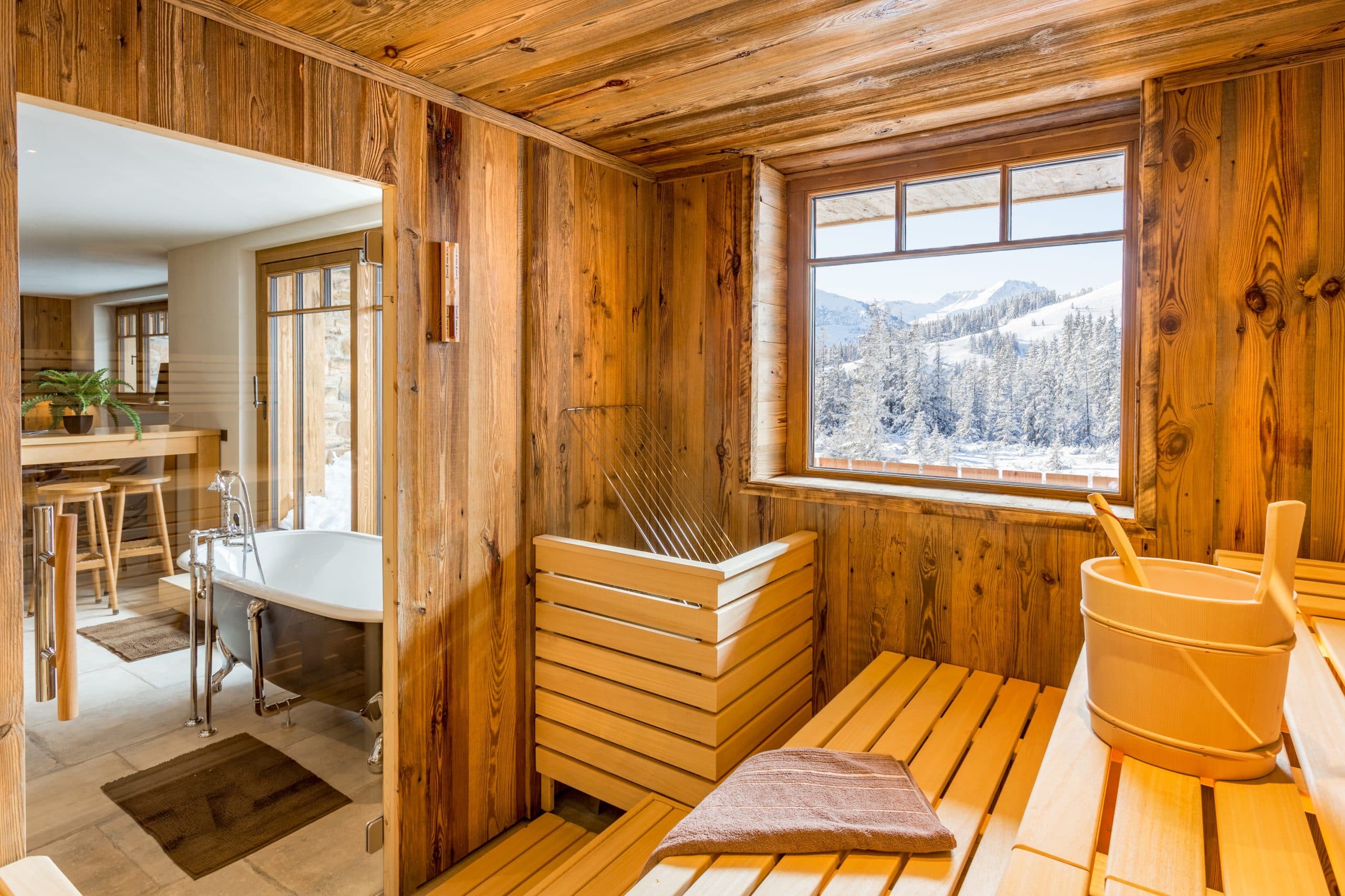
This is the question almost every sauna buyer asks first, and most of the answers online argue over health claims. That is the least useful way to decide. The two heat types feel different, warm up differently, need different wiring, and fit different houses. Those four things are what you will live with. The staff at Mile High Hot Tubs have watched a lot of people change their minds after fifteen minutes in each, and it is almost never a benefits chart that does it.
Here is the comparison of experience and installation reality. If you are earlier in the process and still mapping out the whole purchase, start with our home sauna buyer’s guide for Colorado.
How Each One Makes Heat
A traditional sauna heats the room. An electric element warms a bed of stones; the stones radiate into the air, and the hot air heats you. Temperatures run high, commonly 160 to 195 degrees, and the humidity is low until you pour water on the rocks.
An infrared sauna heats you. Emitters in the walls, bench, and floor produce infrared energy that your body absorbs directly, so the cabin air stays much cooler, usually somewhere between 110 and 150 degrees. Full-spectrum units combine far-infrared, mid-infrared, and near-infrared sources, each sitting at a different wavelength and penetrating differently.
The practical consequence: in a traditional sauna, the air is the thing you notice. In an infrared cabin, the air is unremarkable, and the heat arrives on your skin.
What the Two Actually Feel Like
Traditional heat is intense and immediate. It hits your face and airways in the first breath, and that is exactly what people who love it are after. Sessions are short and punchy, typically ten to twenty minutes at a stretch, often broken into rounds with a cool-down between.
Infrared is slow and enveloping. Nothing about the first two minutes announces itself. The sweat arrives later than you expect and then keeps going, and sessions run longer because the air is not the limiting factor. People who find traditional saunas hard to breathe in usually get along well with infrared. People who want that hit of dry heat on the face often find infrared underwhelming until they stop expecting it to feel like a traditional sauna.
Neither one is better. They are different sensations, and preference between them is close to a coin flip across the people we talk to.
Warm-Up Time and How You’ll Use It
This changes daily behavior more than anything else on the list.
A full-spectrum infrared cabin is usable in roughly ten to twenty minutes, and many can be started from a phone app on the drive home. That makes a weeknight session realistic.
A traditional barrel sauna takes around 45 minutes to reach temperature. The barrel shape helps, because the curved ceiling keeps hot air cycling down across the benches rather than pooling overhead, but there is a large volume of air to bring up and no way around the wait. Traditional sauna use tends to become a planned event rather than a spontaneous twenty minutes.
If your honest use pattern is three short sessions a week after work, warm-up time may decide this for you.
Humidity, Steam, and Why It Matters in Colorado
Only a traditional sauna gives you the option of pouring water over hot stones. The burst of steam that follows raises the perceived heat sharply and adds moisture to air that is otherwise bone dry. In Colorado, where indoor humidity in winter frequently sits uncomfortably low, that matters to some people a great deal.
Infrared cabins are dry by design. There is no water on rocks, no steam, and no humidity control. For anyone whose sinuses object to Front Range winter air, that is a real point of difference worth testing rather than reading about.
Installation and Electrical: The Practical Divide
This is where the two diverge most.
Infrared cabins are largely plug-in appliances. Personal and one-person units run on a standard 110 to 120 volt household outlet. Two-person cabins typically stay at 120 volts and 15 amps. Three-person cabins commonly move to a 120 volt, 20 amp circuit, which means a NEMA 5-20P receptacle rather than the standard one. Larger four-person and lounge-style full-spectrum cabins often step to 230 volts at 15 amps. Assembly is usually tool-free or close to it, and the cabin arrives as flat panels that go together indoors.
Traditional electric heaters are a wiring job. A 6-kilowatt heater wants a 220 to 240 volt, 30 amp hardwired connection. That means a licensed electrician, likely a permit, and a run of wire to wherever the sauna sits. If the sauna is outdoors, that run crosses the yard. Add a level foundation and a shipping weight measured in hundreds of pounds, and the traditional route is a project rather than a delivery.
Where Each Type Fits in a Front Range Home
Infrared cabins overwhelmingly go indoors: finished basements, home gyms, spare bedrooms, large primary bathrooms. They are compact, dry, quiet and electrically undemanding, which is exactly the profile an interior room wants.
Traditional saunas in Colorado are usually outdoors, and usually barrels. The reasons are practical. Outdoors, you are not managing steam inside a finished room, you are not running a 240 volt circuit through a hallway, and the walk back through cold air is half the appeal. A steaming barrel in a snowy backyard is not a marketing image invented by someone in a warmer state. It is the experience, and it is genuinely better in January than in July.
What Each Costs to Run
Running cost follows the wattage and the warm-up.
Infrared cabins draw roughly one to three and a half kilowatts depending on size, and they reach temperature quickly, so a session spends most of its time with the heaters cycling rather than running flat out. A typical weeknight session consumes less electricity than a load of laundry in a resistance dryer.
A 6-kilowatt traditional heater draws several times that, and it also runs for 45 minutes before anyone sits down. Over a month of regular use, the gap is meaningful. It is not usually decisive, but it is real, and it grows if you use the sauna often.
So Which One Should You Buy?
Choose infrared if you want frequent short sessions on weeknights, you are installing indoors, you do not want an electrician involved, or high air temperature makes you uncomfortable.
Choose traditional if the steam and the intensity are the point, you have outdoor space and are willing to build a pad, you enjoy the ritual of a longer session, and you want the option of löyly.
The honest recommendation is to sit in both. Compare the formats on our infrared sauna and barrel sauna pages, then come see what is on the floor. If you are interested in either type, reach out to us to find out what is available and what you can try in person. Our full sauna collection gives you the range, and personal saunas are worth a look if space is the constraint.
Frequently Asked Questions
Is an infrared sauna better than a traditional sauna?
Neither is better in general. Infrared is easier to install, quicker to heat and gentler on the airways. Traditional gets hotter, allows steam, and delivers the classic sauna sensation. The right answer depends on your space, your wiring and which heat you enjoy.
Do infrared saunas make you sweat as much?
Most people sweat heavily in both, but the timing differs. In a traditional sauna, it starts fast. In infrared, it takes longer to begin and then continues through a longer session.
Can you put a traditional sauna indoors?
Yes, but it needs planning: a 240 volt circuit, appropriate wall and ceiling construction, ventilation, and a moisture-tolerant finish if you intend to use water on the stones. Most Colorado homeowners find outdoors simpler.
Which type is cheaper overall?
Infrared usually costs less to install because it avoids the electrician and the foundation, and it costs less to run. Purchase price depends far more on size, spectrum, and features than on heat type alone.
Which one is better for sore muscles after skiing?
Both help, and people are split on which they prefer. If recovery is your main reason for buying, our overview of infrared sauna health benefits covers what the heat is actually doing. If you are weighing heat against water, see hot tubs vs saunas.
Try Both Before You Decide
Fifteen minutes in each type settles this question better than any article can. Come sit in one at a Colorado showroom, or get in touch and we will set up a time that works.

