


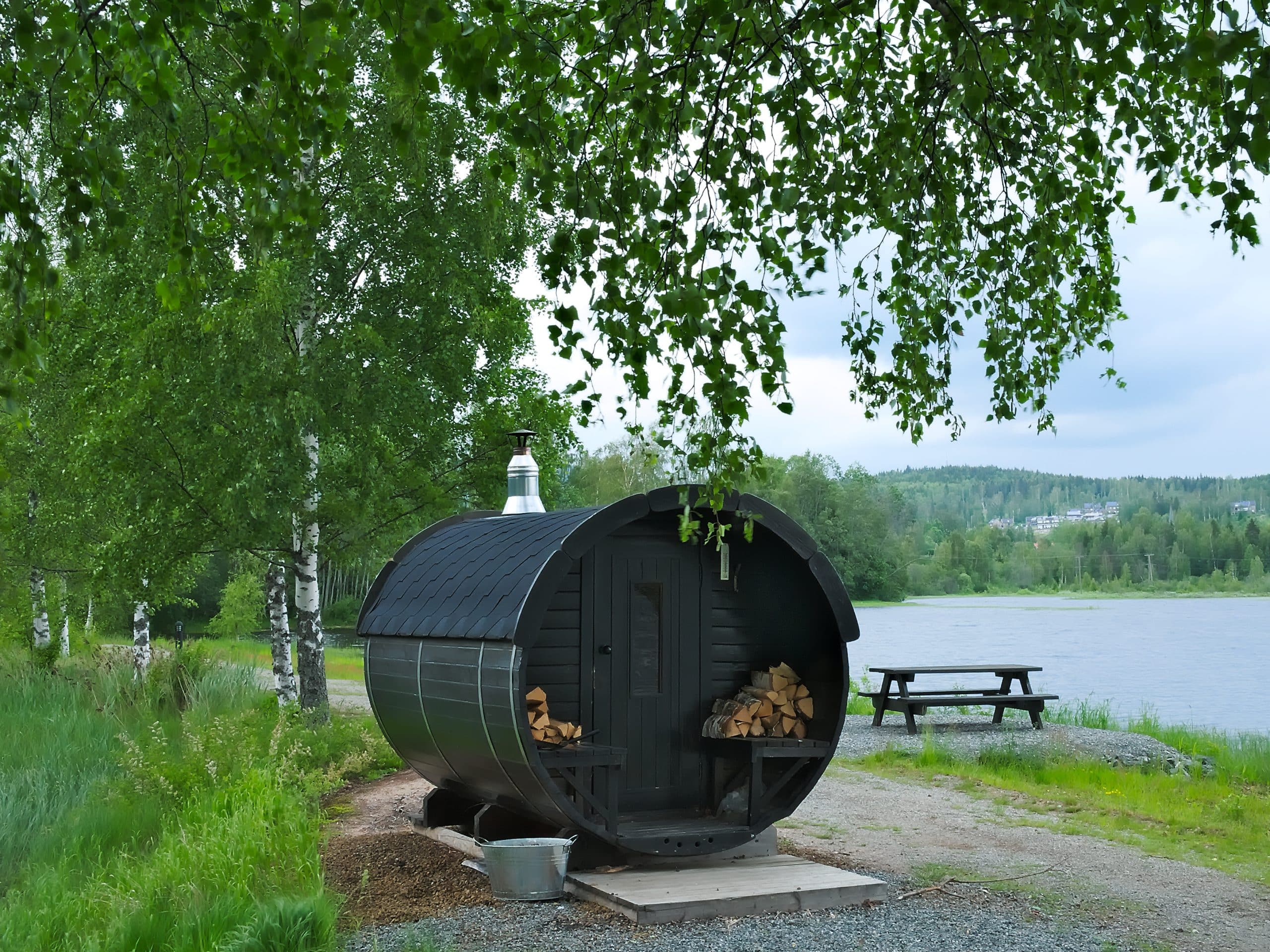
There is a specific Colorado moment that sells outdoor saunas: stepping out of 180-degree heat into air that is twelve degrees and dead still, with steam coming off your shoulders and snow on the fence line. It is worth the build. But it is a build, and the ones that still work well in year five were planned around weather rather than around a photo. Mile High Hot Tubs sees both kinds, and the difference is almost always decided before delivery.
This guide covers the outdoor-specific decisions: barrel or cabin, where to put it, what winter does to it, and what year-round use actually requires. For the broader purchase decision, start with our home sauna buyer’s guide for Colorado.
Barrel or Cabin?
The two outdoor shapes behave differently, and not only visually.
A barrel’s curved ceiling keeps heated air moving in a loop back down across the benches instead of stratifying at the top. That means a smaller volume of genuinely usable hot air and a faster, more even warm-up, roughly 45 minutes for a well-built barrel with a 6-kilowatt heater. Barrels also shed snow and rain on their own, because there is no flat surface for anything to sit on. The trade is headroom at the edges and a floor that is narrower than the widest point.
A cabin gives you vertical walls, full headroom throughout, easier bench layouts and a conventional roof you can insulate heavily. It also gives you a roof that collects snow, and more surface area to heat. Cabins generally take longer to come up to temperature and hold it more evenly once there.
For most Front Range backyards, the barrel is the more forgiving choice. Our barrel sauna page shows how they are built. If you are still weighing outdoor traditional heat against an indoor infrared cabin, the full comparison is in infrared vs traditional sauna.
Siting: Sun, Wind, and the Walk From the Door
Three things decide whether an outdoor sauna gets used in February.
The walk. Measure it. Anything past about thirty feet from a door, on a path that does not get shoveled, becomes a reason not to go. Put the sauna where the path is short and where you will actually clear snow.
Wind. Front Range wind is the quiet enemy of an outdoor sauna. It strips heat off the shell, it drives snow against the door, and it makes the walk out miserable. Use the house, a fence line or existing planting as a windbreak, and orient the door away from the prevailing direction rather than toward the best view.
Sun. Winter sun on the south or west face helps more than you would think, both for heat retention and for keeping the approach clear of ice. It also ages the wood faster. Most people take the trade.
Also check setbacks, easements and any HOA rules before you pour anything. An accessory structure near a property line is a conversation with your jurisdiction, not an assumption.
Snow and Wind Load
Front Range jurisdictions publish their own ground snow load figures, and they climb steeply with elevation. What is routine in Aurora is not what Evergreen or Woodland Park requires. Before you finalize a structure, get the number from your local building department and make sure the unit or the pad detail you are buying is rated for it.
Two practical points regardless of the number. A barrel largely solves this on its own, because snow slides. A flat or low-pitch cabin roof does not, and it needs either a proper pitch or an owner who clears it. And whatever the shape, the sauna needs to be anchored. An empty, well-insulated wooden box is lighter than it looks, and Colorado wind events are not hypothetical.
Foundations in Freeze-Thaw Ground
Colorado soil moves. Water gets in, freezes, expands, and lifts whatever is sitting on it, then drops it unevenly in spring. A sauna that racks out of square stops sealing at the door, and a door that does not seal is a sauna that never quite gets hot.
The workable options are a compacted gravel pad with proper drainage, concrete pavers over a prepared base, a poured slab, or a helical or sonotube pier system for uneven ground. The common thread is drainage and compaction, not thickness. Water that cannot sit under the structure cannot heave it. Our guidance on choosing gravel for a spa base covers the material and compaction principles, which carry over directly.
Foundation detail deserves its own deep dive, and we will publish one. For now: plan drainage first, level second.
Wood Choice and How It Ages Outside
Western red cedar is the default for outdoor saunas for good reason. It is naturally rot resistant, dimensionally stable through heat cycles, low in resin so it does not weep, and it does not get painfully hot to the touch. Fir is a more economical option with a tighter, lighter grain. Thermally modified woods are increasingly common and handle moisture well.
Left alone, cedar silvers to grey within a couple of seasons at Colorado UV levels. That is cosmetic, not structural. If you want to keep the color you need a UV-protective exterior treatment and you need to reapply it, typically every couple of years on the sun-facing side. Never use an interior finish that seals the wood inside the hot room. The interior needs to breathe.
Ventilation
An outdoor sauna needs controlled air exchange, and this is the detail people skip. Fresh air enters low, near the heater, and stale air exits high on the opposite side, usually through an adjustable vent. That loop keeps oxygen in the room, keeps the heat distributing, and lets the cabin dry out after a session. A sauna that cannot dry between uses is a sauna that develops problems in the benches and the floor.
Leave the vent open for a while after you finish, and leave the door cracked. Five minutes of habit prevents most moisture issues.
Winterizing and Genuine Year-Round Use
An outdoor sauna is a cold-weather machine, so winterizing here means keeping it usable rather than shutting it down.
Keep the path and the door area clear, because ice at the threshold is the actual hazard. Clear snow from the vents. Expect a longer warm-up in deep cold and start it earlier rather than turning the thermostat higher. Check the door gasket and hinge alignment at the start of the season, since a door that has dropped even slightly leaks heat continuously. If your sauna has any water feature or plumbing, drain it. And keep the interior dry between uses, which matters more in winter than summer because the door stays shut longer.
Summer use is genuinely different, not worse. Sessions get shorter, the cool-down is a hose or a cold plunge rather than snow, and the warm-up is faster. The case for using heat through the cold months specifically is covered in the benefits of using a sauna in winter.
Power to the Pad
A traditional outdoor heater needs a hardwired circuit, commonly 220 to 240 volts at 30 amps for a 6-kilowatt element. That is a licensed electrician, almost always a permit, and a buried or conduit run from the panel to the pad. Get a quote on that run before you commit to a location, because distance is the cost driver and moving the sauna twenty feet closer to the house can change the number substantially.
Plan lighting on the path at the same time. It is cheap while the trench is open and expensive afterward.
Frequently Asked Questions About Outdoor Saunas in Colorado
Can you use an outdoor sauna in winter?
Yes, and winter is when most owners use theirs most. Expect a longer warm-up in deep cold, keep the vents and door clear of snow and ice, and clear the path.
Does an outdoor sauna need to be insulated?
A quality barrel relies on thick solid lumber rather than cavity insulation, and that works. A cabin with thinner walls needs real insulation and a vapor-appropriate assembly to hold temperature in Colorado cold.
Can an outdoor sauna sit directly on the ground?
No. It needs a level, drained base. Ground contact traps moisture against the structure and freeze-thaw movement will pull it out of square.
How long does an outdoor sauna last in Colorado?
A well-built cedar sauna on a sound foundation lasts many years. UV and moisture do the damage, so the variables are your foundation, your ventilation habits and whether you maintain the exterior finish.
Do I need a permit for an outdoor sauna?
Usually for the electrical, and often for the structure depending on size and your jurisdiction. Call your local building department before ordering.
Plan the Build Before You Buy the Box
Foundation, power run and door orientation are the decisions that determine whether an outdoor sauna gets used all winter. If you are interested in an outdoor or barrel sauna, reach out to see what is available and talk through your site. Browse the full sauna collection, then contact our team and we will help you plan the pad before anything is ordered.

